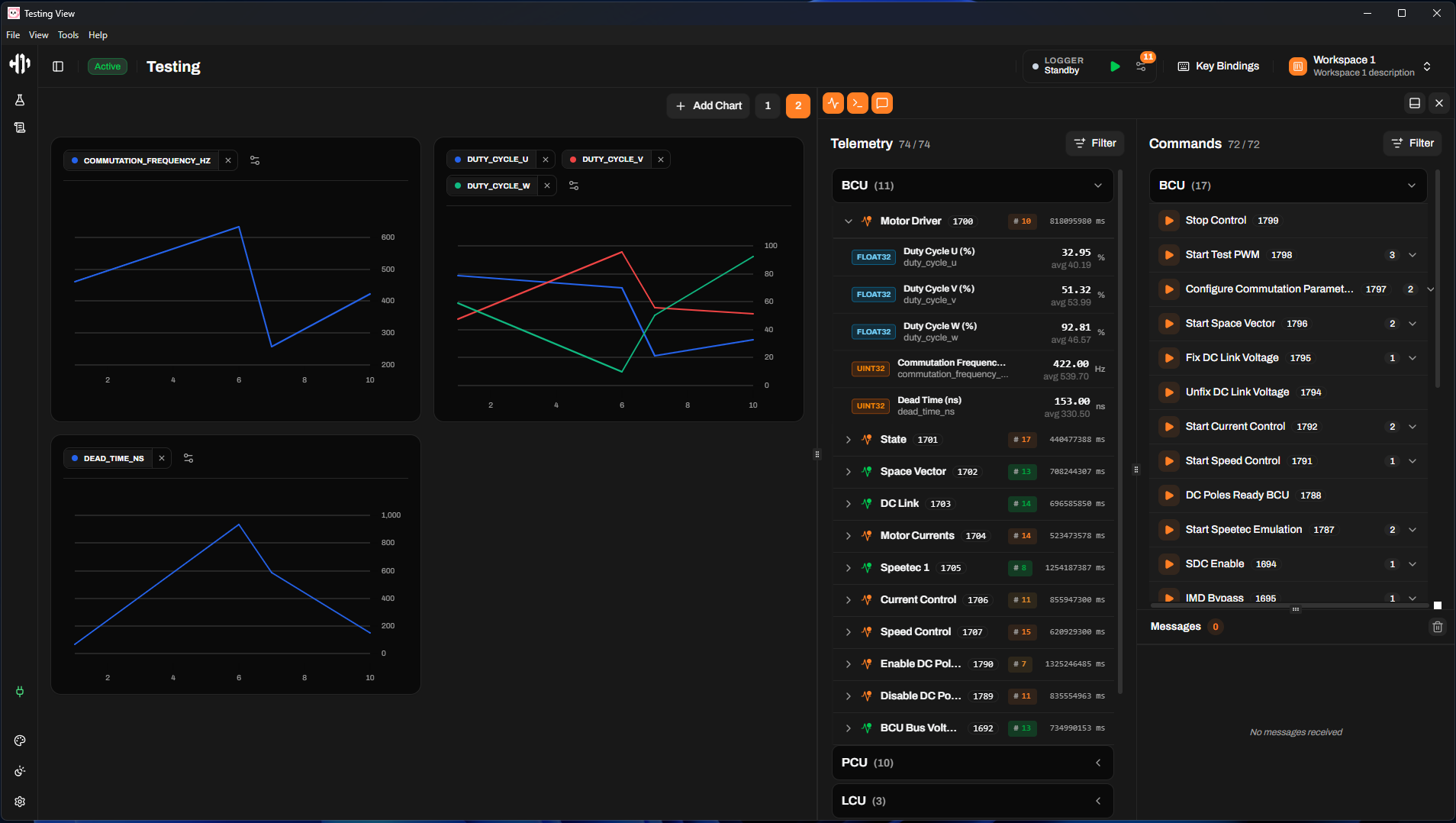
This project implements pnpm workspaces and turbo pack to manage the development lifecycle across multiple languages and frameworks.
Before starting, ensure you have the following installed:
- PNPM (v10.26.0+)
- Node.js (v20+)
- Go (for the backend)
- Python (v3.11+, for the BLCU programming service)
pnpm install automatically creates the Python virtual environment and installs dependencies for the BLCU programming service on Windows, macOS, and Linux.
Our pnpm-workspace.yaml defines the following workspaces:
| Workspace | Language | Description |
|---|---|---|
testing-view |
TS/React | Web interface for telemetry testing |
competition-view |
TS/React | UI for the competition |
flashing-view |
TS/React | UI for flashing firmware to the BLCU board |
backend |
Go | Data ingestion and pod communication server |
blcu-programming |
Python | FastAPI service that flashes firmware to the BLCU board via TFTP |
hyperloop-control-station |
JS | The main Control Station electron desktop application |
e2e |
TS | End-to-end tests for the whole app (Playwright) |
@hyperloopupv/frontend-kit |
TS/React | Shared UI components, hooks, icons and the WebSocket layer (its ./core subpath) |
@hyperloopupv/eslint-config |
ESLint | Common ESLint configuration (frontend-kit) |
@hyperloopupv/typescript-config |
TS | Common TypeScript configuration (frontend-kit) |
These commands should be executed from the root directory (/software).
Note: If you prefer to run scripts from a specific
package.json, you cancdinto the folder and execute them withpnpmwithout filtering.
pnpm dev– Runs both frontends and the backend (withdev-config.toml) in a single terminal window.pnpm dev:main– Runs frontends and the backend using the standardconfig.toml.
All Turbo scripts support filtering to target specific workspaces:
pnpm dev --filter testing-view– Runs thedevscript specifically for the Testing View.
! Important: You must refer to a workspace by the
namefield defined in its localpackage.json.
pnpm build– Compiles every package in the monorepo (Go binaries, Rust crates, and Vite apps).pnpm test– Runs all test suites across the repo (Vitest, Go tests, Cargo tests, and Playwright e2e tests).pnpm lint– Runs ESLint across all TypeScript packages.pnpm preview– Previews the production Vite builds for the frontend applications.
pnpm start– Launches the Electron app directly (requires a prior build).pnpm build:win– Packages the Electron app for Windows.pnpm build:linux– Packages the Electron app for Linux.pnpm build:mac– Packages the Electron app for macOS.
pnpm build:testing-view– Builds only the Testing View frontend.pnpm build:competition-view– Builds only the Competition View frontend.pnpm build:flashing-view– Builds only the Flashing View frontend.
-
pnpm ui:add <component-name>- To add shadcn/ui componentsNote: don't forget to also include it in frontend-kit/kit/src/components/shadcn/index.ts to be able to access it from @hyperloopupv/frontend-kit
Two independent releases, from two workflows that do not touch each other.
| What | Workflow | Produces |
|---|---|---|
| The desktop app | Release Electron App | Tag v<version> and a GitHub release with the installers |
| The shared frontend package | Publish Frontend Kit | @hyperloopupv/frontend-kit on npmjs.com, plus tag frontend-kit-v<version> |
Both are manual, from the Actions tab. The kit versions on its own semver rather than the Control Station's, so a frontend in another repository can read its number and judge an upgrade.
Publishing the kit defaults to a dry run: it builds, packs, prints the tarball and attaches it, without publishing. Run it that way first. A published npm version can never be reused.
The full procedure, what each step of the run does, and the traps worth knowing
before you touch it, are in
frontend/frontend-kit/kit/README.md.