| description | This is the full narrative of how GitGalaxy's claims get tested — the thesis, the |
|---|
This is the full narrative of how GitGalaxy's claims get tested — the thesis, the
three-tool structural benchmark, the cross-language control corpus, the validity
ladder, and the next experiment. README.md carries the summary;
this document carries the whole argument, with every number linked to the artifact
behind it.
GitGalaxy deliberately does not begin by constructing a complete AST for every language.
It uses approximately 97 structural-signal categories to identify things such as:
- function and method boundaries
- classes and declarations
- arguments
- branches and control flow
- state mutation
- I/O
- APIs and routes
- imports and dependencies
- unsafe operations
- reflection and dynamic execution
- concurrency
- closures
- globals
- entropy and physical-file anomalies
This creates a specific, testable hypothesis:
For repository-scale intelligence, targeted structural extraction can recover the entities required for useful code intelligence without requiring a complete language parser for every file.
That hypothesis is being tested empirically, on three independent axes: accuracy against established parsers (below), measurement consistency across languages (the control corpus), and — next — correspondence with real software evolution (risk over Git history).
This is currently one of the most important validation programs in the project.
GitGalaxy is being evaluated against Tree-sitter and Universal Ctags on the same Language Crucible corpus.
The first structural targets are:
- functions
- classes
- arguments
The benchmark is deliberately not treated as a three-tool popularity contest.
When tools disagree:
- the disagreement is recorded;
- the source is inspected;
- each tool's behavior is investigated;
- GitGalaxy is fixed when GitGalaxy is wrong;
- comparator/adaptor code is fixed when the comparator is wrong;
- genuine tool limitations are documented;
- the result is re-measured.
24 of 45 languages get all three tools compared, 13 more get two, and 5
(abap, agc_assembly, dockerfile, jcl, livecode) use committed manual
verification — in whole, or for the args metric where no tool emits a
signature — instead of cross-tool agreement. Of the 201 discrepancy shapes
logged, 200 are validated (99.5%) — read against real source, investigated,
and recorded with a verdict, not just counted.
Current state (2026-08-30), on the pinned corpus:
- Functions — precision: 100.0% validated across all 31 tree-sitter-comparable languages. Once every three-way disagreement is read and verdicted, every function GitGalaxy reports is a real function.
- Functions — recall: 100.0% for 30 of 31. Shell measures 99.8% — a single
nested function definition (inside an
ifguard) that GitGalaxy's top-level-only shell extractor doesn't reach by design. Every other apparent miss is a validated comparison-tool artifact (both tools independently hallucinating the same macro, per-clause tagging of one Haskell function, and so on). - Classes: GitGalaxy is never the tool found wrong in any class disagreement — 100.0% validated recall and precision wherever a class ground truth exists.
- Arguments: GitGalaxy is never debited in any validated argument disagreement either; each one resolves to tree-sitter or ctags miscounting, or a language with no formal parameter list. One small Objective-C shape is still unverified.
This is a narrow benchmark: three structural targets, one fixed corpus, and several languages whose entity counts are small enough that a percentage means little. It is not "GitGalaxy parses as accurately as an AST" in general — it is "for the entities GitGalaxy's graph needs, targeted extraction recovers them as completely as established parsers, here." Real code outside the corpus will surface shapes it doesn't cover; the mandatory occurrence-level recall audit is the standing process for the next one.
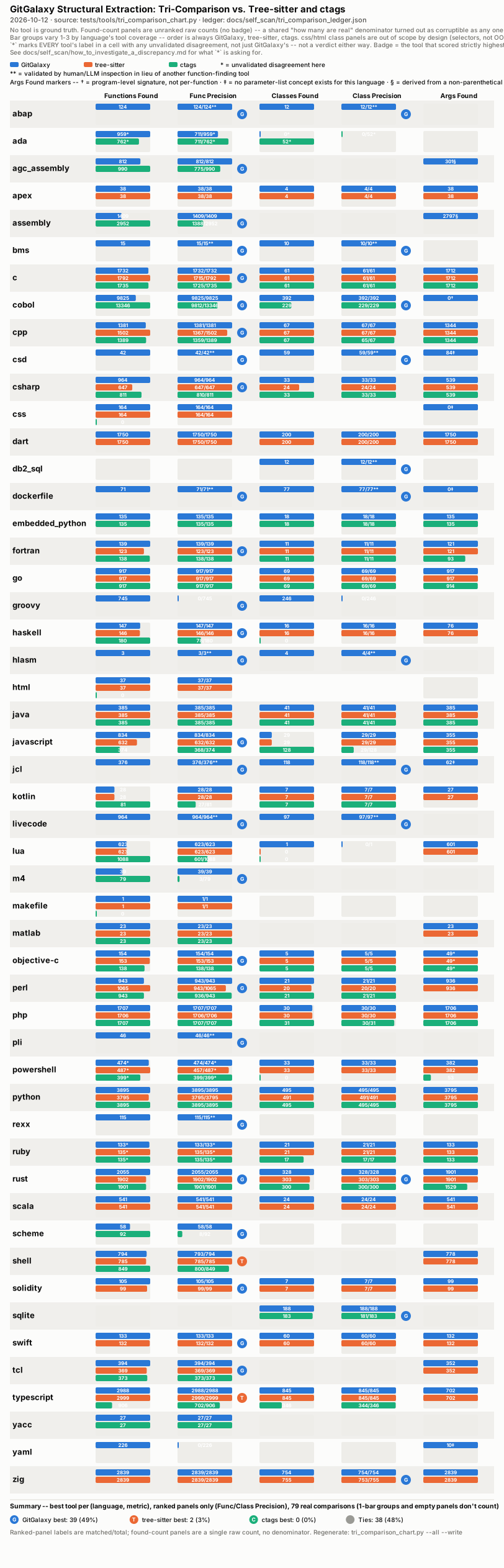
See:
- the tri-comparison methodology doc — how matching, the ledger lifecycle, the recall audit, and CI enforcement work
tests/tools/tri_comparison_chart.pydocs/self_scan/tri_comparison_ledger.json— the full, per-shape validated recorddocs/self_scan/tri_comparison_points_of_interest.md— the same ledger, rendered and ranked by signal strengthdocs/self_scan/how_to_investigate_a_discrepancy.mddocs/self_scan/manual_verification.json
Not:
"Is GitGalaxy a better parser than Tree-sitter?"
But:
"For the structural entities GitGalaxy needs to build its repository graph, how accurately can targeted structural extraction recover them compared with established parsing and indexing systems?"
That is the narrower claim the experiment can support.
Some languages do not currently have a suitable independent Tree-sitter/Ctags comparison path.
Those are kept in a separate evidentiary category and use committed manual verification rather than pretending cross-tool agreement exists.
This currently includes languages such as:
- ABAP
- Dockerfile
- JCL
- LiveCode
- YAML
Where practical, the next step is to add independent lexical, grammar-based, or domain-specific comparators. Where no credible independent comparator exists, human-verified ground truth remains the appropriate category.
The tri-comparison above asks "does GitGalaxy find real structure?" A separate control corpus, keyword-rosetta, asks the orthogonal question: "does GitGalaxy measure identical intent identically across languages?"
The same 12-probe, functions-only program shell is hand-planted in all 46 supported languages, with the exact count of every signal keyword known in advance. Any column-to-column divergence on that corpus is measured language bias — an extraction inequality or a scoring inequality — because the planted intent is identical by construction.
Current results
(bias report):
on average 94% of languages sit within ±25% of the cross-language median per gated
metric (56 chartable metrics, 54 holding ≥80%), and the open-defect share is 0.0%
(1 of 2,844 comparable cells across 59 gated metrics): a single unexplained cell,
classes_found in the newly planted bms (CICS Basic Mapping Support) corpus. Every
other out-of-band cell is a variation the ledger has validated (a strictness stratum, a
construct the language cannot express, an echo of another row, or a deliberate scoring
choice), not an open engine defect. The chart colours each deviation by cause, not
size: red is an open engine defect (a rule matching the wrong construct, or a scoring
weight sitting inside a count); grey is a documented variation the ledger has validated.
The weakest metrics are named rather than hidden: cog_raw holds 74% of languages in
band, raw_arch_api 78%, avg_func_args 80%; their sub-band cells are documented, not
defects. The work is tracked by cause family under the
contract roadmap.
The consistency claim also survives expansion on demand. When the corpus
planted its first security-lens probe — one identical comment-form
hardcoded secret in every language's shell — risk_secrets_risk went from
inert to a scored metric reading a uniform value across all 44 languages
the lens covers, in one screened change. The two languages reading 0
(markdown, yaml) were not misses: the engine deliberately skipped its
security lens on inert data formats, a boundary ledgered and filed as a
design question (#2978)
and since closed — the lens now runs on all five inert formats
(plaintext/markdown/json/yaml/csv), opt-out via SECURITY_SCAN_INERT_FORMATS.
The same regeneration measured the formula's length dependence (Spearman
ρ = −0.91 against file length with inputs held equal) and filed it as
score-contract work (#2979)
— the instrument finding its next finding on the day it was extended. The
commit-age context group reads measured git history as well, since the
chronometer resolves history for subdirectory scans
(#2976).
Every known deviation is recorded in a validated deviation ledger, and the defect classes found this way are filed as GitGalaxy issues — see the findings-by-language index. A companion incidence report sizes each confirmed shape against real licensed code, separating constant per-file biases (e.g. PHP's open tag counting as a branch in 100% of files) from sparse per-repo hazards.
What this proves and doesn't: a control corpus demonstrates measurement inequality on identical intent with zero ambiguity, but says nothing about accuracy on real code (that's the tri-comparison's job) and nothing about whether a biased metric is still usefully ranked within a single language (a constant per-file offset preserves ordering inside that language).
GitGalaxy's evidence is being organized around progressively stronger questions.
Does GitGalaxy correctly identify code structures?
Tree-sitter + Ctags + independently investigated disagreements. See "Structural validation" above.
Does GitGalaxy measure the same intent the same way in every language?
The Keyword Rosetta control corpus above — exact planted signal counts, 46 languages, validated deviation ledger.
Does the implementation remain stable on real code?
Golden-master testing against Language Crucible.
Does it work on real repositories?
Unedited raw scan output from hundreds of repositories.
Do structural signatures correspond to the exposure categories they are intended to represent?
Statistical analysis against independently observable outcomes---not merely against GitGalaxy's own equations.
Does exposure behave sensibly as software changes?
Git-history analysis comparing repository states before and after real changes.
Do exposure changes correspond to independently documented security or maintenance outcomes?
Future work: security fixes, regressions, advisories, defects and other external event datasets.
This distinction matters: a score can be internally consistent without necessarily being externally meaningful.
Moved here from the README on 2026-10-12, unchanged apart from link paths. The README keeps a short summary that links to this section.
GitGalaxy's 13 per-file vectors were originally named risk_* and described as
risk-exposure measurements. The question this section used to leave open —
"are these signatures empirically associated with meaningful classes of
software risk?" — has since been tested, not just asked. The
temporal-crucible validation program (epic
#2982, ~3,550
scanned snapshots, two repositories, three label families, every test
pre-registered before the data was looked at) ran that experiment to
exhaustion, and the honest result drove a rename
(#2991): the
vectors are now called the Structural Surface Profile. risk_* remains
the DB column / JSON key name for compatibility (see
docs/vectors.md for the full name table and the
deprecation note).
What the record found, restated honestly:
- Per-file standing risk, falsified. The founding hypothesis — that a
file's
risk_*level, or its change after a fix, tracks defect probability — did not hold. Median structural delta after a security fix was +0.000 (equivalence-confirmed near-zero on a second, independent repository, not just non-significant); summed structural exposure ranked last of six features for predicting fix-touched files; a 26-signal multivariate structural vector scored at chance (AUC 0.479) under a temporal split, below a plain line count (0.531). The full ledger is in temporal-crucible'sdocs/HYPOTHESES.mdand is linked from #2982. - What the vectors actually validated for: describing activity and
content, not defect probability. The fix-shaped composite reliably
tracks a security-fix → ordinary-fix → control → revert gradient; deltas
correspond to real code events (guard code added, threading introduced,
debt markers diluted). That's the x-ray this document now names
accurately — see
docs/vectors.mdvector-by-vector. - System-level / history signal, restated as the actual predictive
finding. Two features did survive validation: recidivism (the file
that had the last fix gets the next one — the single most replicated
result of the program, p<1e-4 on both repositories) and change entropy /
Hassan HCM, validated out-of-selection on fresh bug labels (AUC 0.868 vs
a line count's 0.830). Both are history metrics, not structural
content metrics — and both are currently zeroed in every scan
(
GITGALAXY_DISABLE_GIT_HISTORY, tracked in temporal-crucible#29). This is the seed of a separate, honestly-named predictive layer — thehist_stability/hist_churnvectors are named to mark that status explicitly — gated on shipping history-enabled mode and then clearing #2987's defect-lift promotion contract.
A high Structural Surface Profile reading means:
This location has more of a given structural/content pattern present, relative to the rest of the repository.
It does not mean:
"This code is more likely to contain a defect" — the per-file version of that claim was tested and did not hold.
The underlying signatures cover patterns involving areas such as:
- secrets
- injection surface
- unsafe/memory operations
- dynamic execution
- I/O
- concurrency
- state mutation
- reflection
- APIs
- dependencies
- entropy
- other structural/security characteristics
See docs/vectors.md for the per-vector rename table,
evidence, and appropriate/inappropriate uses, and
temporal-crucible's
docs/HYPOTHESES.md for the full validation ledger this section summarizes.
Whether the Structural Surface Profile corresponds to real security and maintenance events over Git history is no longer an open question — it has been tested. The Temporal Crucible program scanned ~3,550 repository snapshots across two repositories (curl, nDPI) and three label families (CVE fix/introduce commits, bug labels, CWE families), with every confirmatory test pre-registered before the data was looked at. What it found, stated honestly:
- Per-file standing structural risk does not predict defects — it reduces to a line count, a null confirmed by equivalence testing on a second, independent repository (not merely "not significant").
- Two history metrics do predict: recidivism (the file that had the last fix gets the next one — p<1e-4 on both repositories, the most replicated result of the program) and change entropy (Hassan HCM), validated out-of-selection on fresh bug labels.
- Structure describes; history predicts. More predictions died in the ledger than survived it — that is the pre-registration discipline working, not a disappointment.
The full record is public and reproducible: the pre-registered hypothesis ledger and a predictor × outcome index of everything the program has tried to correlate. Design and method: the validation program.
Once structural validation is sufficiently mature, GitGalaxy can test its exposure model longitudinally.
Git history
    |
    v
security-relevant event
    |
    +-------------------+
    |                   |
    v                   v
parent state        changed state
    |                   |
    v                   v
GitGalaxy scan      GitGalaxy scan
    |                   |
    +---------+---------+
              |
              v
        exposure delta
              |
              v
     independent event class
The central experiment is:
Do commits independently identified as security fixes typically reduce the corresponding GitGalaxy exposure?
Negative controls are equally important:
Do ordinary development commits show the same behavior?
Eventually:
Do security regressions increase exposure?
The planned harness will preserve commit SHA, parent state, changed files/functions, exposure before/after, exposure deltas, structural changes and event classification.
That tests:
structure → exposure → real software evolution
rather than merely testing the internal mathematics of the exposure model.
GitGalaxy is moving through a sequence of increasingly difficult questions:
Can we scan heterogeneous source without compiling it?
↓
Can we reliably recover the structural entities needed to understand it?
↓
Do those structural measurements correspond to defect risk? (Answered — no: the temporal-crucible program (#2982) found the structural vectors reduce to file size and do not predict defects. They were renamed from "risk exposure" to the Structural Surface Profile (#2991); they measure surface area and activity. History metrics — recidivism, change entropy — are the predictive layer. See
vectors.md.)
↓
Does the measured surface profile behave correctly as real software evolves? (Yes — per-vector deltas track real code events: guard code added, threading introduced, debt markers diluted, cleanly across a security-fix → fix → control → revert gradient.)
The Tree-sitter/Ctags validation is currently about halfway complete. The immediate priority is to finish that audit before turning preliminary measurements into stronger claims.
The next major experiment is:
Git history → independently identified change/fix events → GitGalaxy before/after scans → exposure deltas → statistical analysis.
That is where GitGalaxy can begin testing not only whether it sees structure, but whether its structural model tracks meaningful changes in real software.