
Python package for automatic Korean word spacing.
R verson can be found here.


Tip
New: KoSpacing v2. An optional LLM-based backend, Spacing(backend='v2'), built on
kotag-0.8B. It is more accurate than v1 on 3 of 4 test sets, fixes
spacing that is already there, and gives per-character probabilities.
See KoSpacing v1 and KoSpacing v2 →
Word spacing is one of the important parts of the preprocessing of Korean text analysis. Accurate spacing greatly affects the accuracy of subsequent text analysis. PyKoSpacing has fairly accurate automatic word spacing performance,especially good for online text originated from SNS or SMS.
For example.
"아버지가방에들어가신다." can be spaced both of below.
- "아버지가 방에 들어가신다." means "My father enters the room."
- "아버지 가방에 들어가신다." means "My father goes into the bag."
Common sense, the first is the right answer.
PyKoSpacing is based on Deep Learning model trained from large corpus(more than 100 million NEWS articles from Chan-Yub Park).
| Test Set | Accuracy |
|---|---|
| Sejong(colloquial style) Corpus(1M) | 97.1% |
| OOOO(literary style) Corpus(3M) | 94.3% |
- Accuracy = # correctly spaced characters/# characters in the test data.
- Might be increased performance if normalize compound words.
Pre-requisite:
proper installation of python3
proper installation of pip

pip install tensorflow
pip install keras


Windows-Ubuntu case: On following error.
On error: /usr/lib/x86_64-linux-gnu/libstdc++.so.6: version `GLIBCXX_3.4.22' not found
   sudo apt-get install libstdc++6
   sudo add-apt-repository ppa:ubuntu-toolchain-r/test
   sudo apt-get update
   sudo apt-get upgrade
   sudo apt-get dist-upgrade (This takes long time.)
Darwin(m1) case: You should install tensorflow in a different way.(Use Miniforge3)
# Install Miniforge3 for mac
curl -O https://github.com/conda-forge/miniforge/releases/latest/download/Miniforge3-MacOSX-arm64.sh
chmod +x Miniforge3-MacOSX-arm64.sh
sh Miniforge3-MacOSX-arm64.sh
# Activate Miniforge3 virtualenv
# You should use Python version 3.10 or less.
source ~/miniforge3/bin/activate
# Install the Tensorflow dependencies
conda install -c apple tensorflow-deps
# Install base tensorflow
python -m pip install tensorflow-macos
# Install metal plugin
python -m pip install tensorflow-metal
To install from GitHub, use
pip install git+https://github.com/haven-jeon/PyKoSpacing.git
>>> from pykospacing import Spacing
>>> spacing = Spacing()
>>> spacing("김형호영화시장분석가는'1987'의네이버영화정보네티즌10점평에서언급된단어들을지난해12월27일부터올해1월10일까지통계프로그램R과KoNLP패키지로텍스트마이닝하여분석했다.")
"김형호 영화시장 분석가는 '1987'의 네이버 영화 정보 네티즌 10점 평에서 언급된 단어들을 지난해 12월 27일부터 올해 1월 10일까지 통계 프로그램 R과 KoNLP 패키지로 텍스트마이닝하여 분석했다."
>>> # Apply a list of words that must be non-spacing
>>> spacing('귀밑에서턱까지잇따라난수염을구레나룻이라고한다.')
'귀 밑에서 턱까지 잇따라 난 수염을 구레나 룻이라고 한다.'
>>> spacing = Spacing(rules=['구레나룻'])
>>> spacing('귀밑에서턱까지잇따라난수염을구레나룻이라고한다.')
'귀 밑에서 턱까지 잇따라 난 수염을 구레나룻이라고 한다.'
Setting rules with csv file. (you only need to use set_rules_by_csv() method.)
$ cat test.csv
인덱스,단어
1,네이버영화
2,언급된단어>>> from pykospacing import Spacing
>>> spacing = Spacing(rules=[''])
>>> spacing.set_rules_by_csv('./test.csv', '단어')
>>> spacing("김형호영화시장분석가는'1987'의네이버영화정보네티즌10점평에서언급된단어들을지난해12월27일부터올해1월10일까지통계프로그램R과KoNLP패키지로텍스트마이닝하여분석했다.")
"김형호 영화시장 분석가는 '1987'의 네이버영화 정보 네티즌 10점 평에서 언급된단어들을 지난해 12월 27일부터 올해 1월 10일까지 통계 프로그램 R과 KoNLP 패키지로 텍스트마이닝하여 분석했다."Run on command line(thanks lqez).
$ cat test_in.txt
김형호영화시장분석가는'1987'의네이버영화정보네티즌10점평에서언급된단어들을지난해12월27일부터올해1월10일까지통계프로그램R과KoNLP패키지로텍스트마이닝하여분석했다.
아버지가방에들어가신다.
$ python -m pykospacing.pykos test_in.txt
김형호 영화시장 분석가는 '1987'의 네이버 영화 정보 네티즌 10점 평에서 언급된 단어들을 지난해 12월 27일부터 올해 1월 10일까지 통계 프로그램 R과 KoNLP 패키지로 텍스트마이닝하여 분석했다.
아버지가 방에 들어가신다.
Current model have problems in some cases when the input includes English characters.
PyKoSpacing provides the parameter ignore and ignore_pattern to deal with that problem.
-
About
ignoreparameter (str, optional)ignore='none': No pre/post-processing will be applied. The output will be the same as the model output.ignore='pre': Apply pre-processing which deletes characters that match withignore_pattern. These deleted characters will be merged after model prediction. This option has the problem that it always puts space after the deleted characters, since it doesn't know if the deleted character will have a space to the left, right, or both of them.ignore='post': Apply post-processing which ignores model outputs on characters that match withignore_pattern. This option has the problem that English characters in model input can also affect near non-English characters.ignore='pre2': Apply pre-processing which delete characters which matches withignore_pattern, and predict on both preprocessed text and original text. This allows it to know where to put space left, right, or both of the deleted characters. However, this option requires to predict twice, which doubles the computation time.- Default:
ignore='none'
-
About
ignore_patternparameter (str, optional)
You can input your own regex pattern toignore_pattern. The regex pattern should be the pattern of characters you want to ignore.- Default:
ignore_pattern=r'[^가-힣ㄱ-ㅣ!-@[-`{-~\s]+,*( [^가-힣ㄱ-ㅣ!-@[-`{-~\s]+,*)*[.,!?]* *', which matches characters, words, or a sentence of non-Korean and non-ascii symbols.
- Default:
Examples of ignore parameter
>>> from pykospacing import Spacing
>>> spacing = Spacing()
>>> spacing("친구와함께bmw썬바이저를썼다.", ignore='none')
"친구와 함께 bm w 썬바이저를 썼다."
>>> spacing("친구와함께bmw썬바이저를썼다.", ignore='pre')
"친구와 함께bmw 썬바이저를 썼다."
>>> spacing("친구와함께bmw썬바이저를썼다.", ignore='post')
"친구와 함께 bm w 썬바이저를 썼다."
>>> spacing("친구와함께bmw썬바이저를썼다.", ignore='pre2')
"친구와 함께 bmw 썬바이저를 썼다."

>>> spacing("chicken박스를열고닭다리를꺼내입에문다.crispy한튀김옷덕에내입주변은glossy해진다.", ignore='none')
"chicken박스를 열고 닭다리를 꺼내 입에 문다. crispy 한튀김 옷 덕에 내 입 주변은 glossy해진다."
>>> spacing("chicken박스를열고닭다리를꺼내입에문다.crispy한튀김옷덕에내입주변은glossy해진다.", ignore='pre')
"chicken박스를 열고 닭다리를 꺼내 입에 문다.crispy 한 튀김옷 덕에 내 입 주변은glossy 해진다."
>>> spacing("chicken박스를열고닭다리를꺼내입에문다.crispy한튀김옷덕에내입주변은glossy해진다.", ignore='post')
"chicken박스를 열고 닭다리를 꺼내 입에 문다. crispy 한튀김 옷 덕에 내 입 주변은 glossy해진다."
>>> spacing("chicken박스를열고닭다리를꺼내입에문다.crispy한튀김옷덕에내입주변은glossy해진다.", ignore='pre2')
"chicken박스를 열고 닭다리를 꺼내 입에 문다. crispy 한 튀김옷 덕에 내 입 주변은 glossy해진다."

>>> spacing("김형호영화시장분석가는'1987'의네이버영화정보네티즌10점평에서언급된단어들을지난해12월27일부터올해1월10일까지통계프로그램R과KoNLP패키지로텍스트마이닝하여분석했다.", ignore='none')
"김형호 영화시장 분석가는 '1987'의 네이버 영화 정보 네티즌 10점 평에서 언급된 단어들을 지난해 12월 27일부터 올해 1월 10일까지 통계 프로그램 R과 KoNLP 패키지로 텍스트마이닝하여 분석했다."
>>> spacing("김형호영화시장분석가는'1987'의네이버영화정보네티즌10점평에서언급된단어들을지난해12월27일부터올해1월10일까지통계프로그램R과KoNLP패키지로텍스트마이닝하여분석했다.", ignore='pre')
"김형호 영화시장 분석가는 '1987'의 네이버 영화 정보 네티즌 10점 평에서 언급된 단어들을 지난해 12월 27일부터 올해 1월 10일까지 통계 프로그램R과KoNLP 패키지로 텍스트마이닝하여 분석했다."
>>> spacing("김형호영화시장분석가는'1987'의네이버영화정보네티즌10점평에서언급된단어들을지난해12월27일부터올해1월10일까지통계프로그램R과KoNLP패키지로텍스트마이닝하여분석했다.", ignore='post')
"김형호 영화시장 분석가는 '1987'의 네이버 영화 정보 네티즌 10점 평에서 언급된 단어들을 지난해 12월 27일부터 올해 1월 10일까지 통계 프로그램 R과 KoNLP 패키지로 텍스트마이닝하여 분석했다."
>>> spacing("김형호영화시장분석가는'1987'의네이버영화정보네티즌10점평에서언급된단어들을지난해12월27일부터올해1월10일까지통계프로그램R과KoNLP패키지로텍스트마이닝하여분석했다.", ignore='pre2')
"김형호 영화시장 분석가는 '1987'의 네이버 영화 정보 네티즌 10점 평에서 언급된 단어들을 지난해 12월 27일부터 올해 1월 10일까지 통계 프로그램 R과 KoNLP 패키지로 텍스트마이닝하여 분석했다."PyKoSpacing has two models.
- KoSpacing v1 (
backend='v1', default): the original TensorFlow model described below. Small and fast on CPU. - KoSpacing v2 (
backend='v2', experimental): an instruction-following sequence tagger, Qwen3.5-0.8B with a per-character readout, published as gogamza/kotag-0.8b. Besides spacing, it corrects spacing that is already there (fix()), gives per-character probabilities (space_probs()), and spaces a list of strings as one batch. It needs no TensorFlow.
>>> from pykospacing import Spacing
>>> spacing = Spacing(backend='v2')        # downloads gogamza/kotag-0.8b; checkpoint= takes another repo or a directory
>>> spacing('아버지가방에들어가신다')
'아버지가 방에 들어가신다'
>>> spacing.fix('오늘은날씨가 정말좋 네요. 산책 가실분?')       # keeps the spaces that are right
'오늘은 날씨가 정말 좋네요. 산책 가실분?'
>>> spacing(['밥먹었어', '오늘날씨가좋다'])                     # batch
>>> spacing.space_probs('아버지가방에')                          # [(char, P(space after)), ...]
Install with the v2 dependencies: pip install "pykospacing[v2] @ git+https://github.com/haven-jeon/PyKoSpacing.git". The model is downloaded from
gogamza/kotag-0.8b on first use, or checkpoint= gives another repo id or a local directory. Setup, offline use and CPU/GPU notes:
docs/kospacing-v2.md.
Word F1 on the kospacing test sets, all test sentences (higher is better; KoSpacing v2 is gogamza/kotag-0.8b v1.0):
| Test set | KoSpacing v1 | KoSpacing v2 |
|---|---|---|
| Wikipedia sentences, spaces removed | 0.824 | 0.841 |
| KLUE-NER validation (news, reviews), spaces removed | 0.788 | 0.754 |
| KOLD comments, spaces removed (gold is the writer's own spacing) | 0.630 | 0.684 |
Wikipedia with noisy spacing (15% of spaces dropped, 6% added), v2 fix() |
0.820 | 0.919 |
| same, whole sentence correct | 0.264 | 0.514 |
On the noisy-spacing rows v1 is scored in its best mode: spaces removed, then spaced again. Passing the noisy text as is gives 0.730 / 0.140, because v1 trusts the existing spaces.
| KoSpacing v1 | KoSpacing v2 | |
|---|---|---|
| Model size | 2.4 MB | 1.7 GB |
| Runs on | CPU | GPU recommended |
| Needs | TensorFlow | PyTorch, transformers, safetensors, huggingface_hub |
Speed (scripts/bench_pykospacing.py in kospacing; test sentences of 43 to 50 characters on average, spaces removed;
NVIDIA GB10 with a 20-core Arm CPU, 10x Cortex-X925 + 10x Cortex-A725):
| v1 on CPU | v2 on CPU | v2 on GPU | |
|---|---|---|---|
| One sentence per call, median latency | 11 ms | 1,150 ms | 18 ms |
| One sentence per call, throughput | 83 sentences/s (4,100 chars/s) | 0.83 sentences/s (36 chars/s) | 55 sentences/s (2,800 chars/s) |
| A list in one call, throughput | – | 0.97 sentences/s (48 chars/s) | 69 sentences/s (3,500 chars/s) |
| Model load | 1.5 s | 4.8 s | 13.7 s (with CUDA start-up) |
- v1 takes one string per call.
- On CPU, v2 runs in float32 with PyTorch's reference linear-attention code (the fast kernels are GPU-only). More torch threads barely help (8: 1,150 ms, 20: 1,120 ms). On GPU it runs in bfloat16; CPU and GPU outputs agreed on 49 of 50 test sentences.
- On GPU, v2 is about 65 times faster than on CPU, and a single call takes about as long as v1 on CPU (18 ms vs 11 ms).
Measured with
flash-linear-attentioninstalled and withoutcausal_conv1d(transformers then uses PyTorch code for the short convolutions). - v2 on CPU is about 100 times slower than v1. Use it on a GPU, or where its spacing correction matters more than speed.
Why a tagger and not a chat model asked to write the answer: the same word spacing by the base model Qwen3.5-0.8B
without fine-tuning, which has to generate its answer token by token (scripts/bench_generative.py in kospacing; 30
test sentences of about 58 characters, one at a time, same GB10 GPU, greedy decoding with transformers, about 14 ms per
generated token):
| Approach | Latency per sentence | Generated tokens | Word F1 |
|---|---|---|---|
| KoSpacing v2: one forward pass, no generation | 19 ms | 0 | 0.817 |
| Qwen3.5-0.8B, writes the spaced sentence | 596 ms | 48 | 0.326 |
Qwen3.5-0.8B, writes JSON labels ({"labels": [0, 1, ...]}) |
7,077 ms | 422 | 0.006 (4 of 30 valid) |
Generation time grows with the length of the answer, and one label per character makes it long; KoSpacing v2 reads every label from one forward pass.
ignore= applies to v1 only: v2 reads Latin letters, digits and symbols directly.
Tests: python -m unittest tests.test_v2. The model tests run when PYKOSPACING_V2_CHECKPOINT is set.

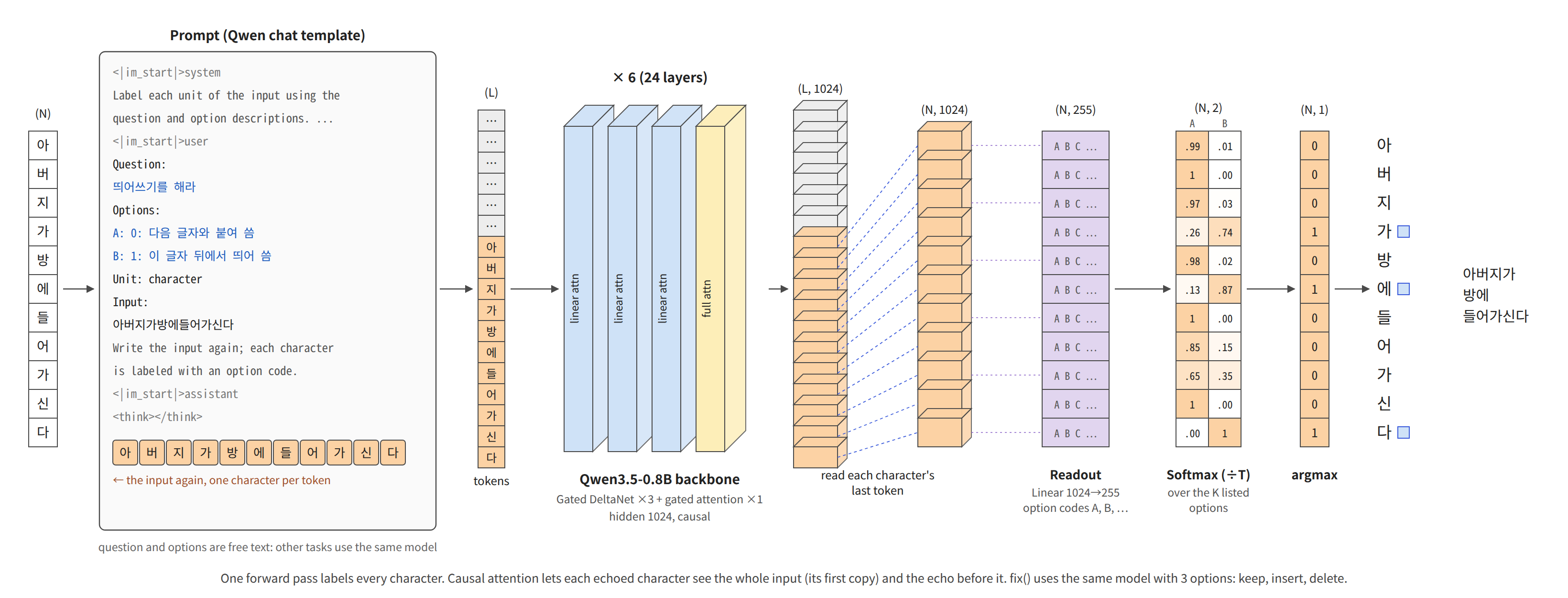
The prompt states the question and the options, then repeats the input one character per token. One forward pass of
the Qwen3.5-0.8B backbone gives a hidden state at each repeated character; a readout over the option codes scores the
options there (probabilities above: gogamza/kotag-0.8b v1.0).
- Training code uses an architecture that is more advanced than PyKoSpacing, but also contains the learning logic of PyKoSpacing.
@misc{heewon2018,
author = {Heewon Jeon},
title = {KoSpacing: Automatic Korean word spacing},
publisher = {GitHub},
journal = {GitHub repository},
howpublished = {\url{https://github.com/haven-jeon/KoSpacing}}